
Variable rate used to mean hiring an agronomist,
buying mapping software, and hoping
the file loaded on your console.
Weist Farms W02 field: soil sampled, 10-zone phosphorus prescription built, loaded to Topcon TAP, applied pass-by-pass on May 6, 2026. No GIS consultant. No file reformatting. No phone call to the agronomist asking why the zone map didn't load. The prescription ran the day FarmTech delivered it.
The challenge
Variable-rate fertilizer application has existed for decades. So has the frustration with actually using it. The standard path — hire an agronomist, get a soil test, pay a GIS consultant to build a zone map, purchase prescription software, export a file in the format your console happens to accept, debug the file when it doesn't load, hope the pass aligns with the zones — costs more in time and professional fees than many operations see in input savings.
The result: most operations know their fields have variability. They see it in yield maps. They see it when the northwest corner of a field always runs dry or the low spot always outperforms. But closing the loop from "I know it varies" to "my equipment is applying differently based on what the soil actually needs" has historically required overhead that eliminated the ROI.
The solution
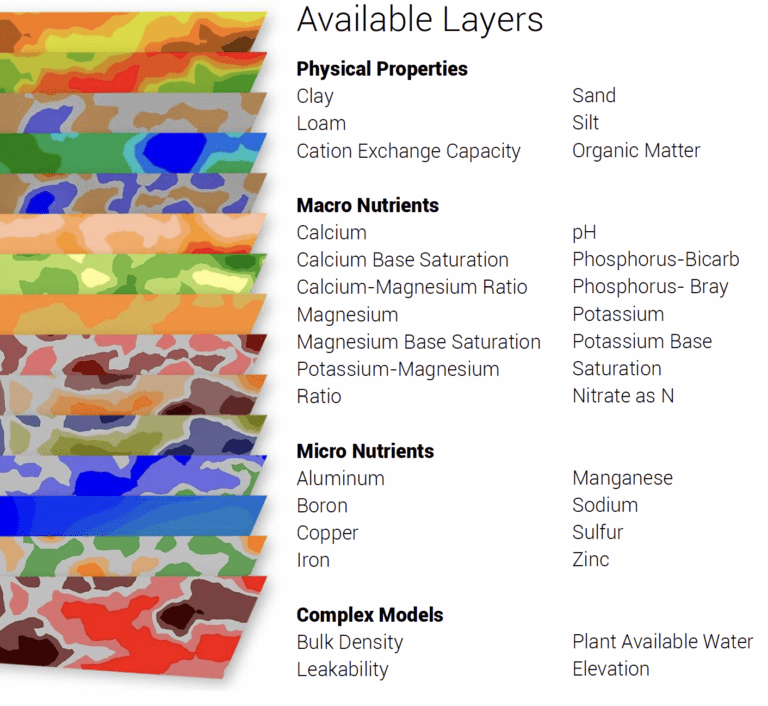
FarmTech's SoilOptix service samples Weist Farms fields at grid density sufficient to differentiate zones — not the 2.5-acre composite that gives you one number per field, but the sampling resolution that reveals how much it actually varies within the field.
The W02 field produced 10 distinct prescription zones. Phosphorus rates ranged from 15 to 125 lbs MAP per acre — an 8x range across a single field. Applied uniformly at any rate, the field is either over-applied in the high-P zones, under-applied in the depleted zones, or both.
FarmTech built the prescription, exported it in the format Weist's console reads, and loaded it straight to the Topcon TAP console. On May 6, 2026, the seeder ran the field applying what each zone actually needed. No GIS work by Weist Farms. No file conversion. No agronomist on the phone. The pass ran the day the files arrived.
Soil sample → prescription → console → applied.
Zero manual GIS work.
This is what the pipeline looks like in practice:
- FarmTech samples the field — GPS-referenced grid, NAPT-certified lab
- Lab results come back — P levels per grid point, full nutrient panel
- FarmTech builds the prescription — agronomist-set zones, target P balance for the 45 bu/ac yield goal
- Prescription delivered in the format the console reads — loads like any other file
- Seeder runs the field — the console applies what each zone needs, pass by pass
- As-applied data flows back into FarmIQ — the prescription and the actual application are in the same record
The first time this pipeline ran end-to-end on a live field was W02, spring 2026. It worked. The prescription loaded. The seeder applied it. The as-applied record came back clean.
"We've known the northwest corner of W02 runs light for years. Now the seeder actually applies less phosphorus there — because that's what the soil says it needs. The prescription ran day one. No fuss."
What the W02 prescription delivered
10-zone variable-rate prescription
Built from grid-density soil sampling, not guesswork. 15 to 125 lbs MAP per acre — the seeder applies what each zone actually needs to hit the 45 bu/ac yield goal, not what the worst acre requires.
Topcon TAP — loaded, no conversion
The prescription from FarmTech loads directly to the console in the format it already reads. No GIS software. No file conversion. It runs on the console already in the cab — the one the operator already knows how to use.
As-applied record in FarmIQ
The run data flows back to FarmIQ automatically. The prescription and the as-applied are in the same record. Year over year, that comparison is the data that tells you whether the soil is responding, whether the yield goal is calibrated right, and whether the zones need refinement.
This is the service, not a prototype
The W02 prescription ran on a production seeder during the 2026 spring planting window. This isn't a field trial — it's the pipeline that FarmTech delivers to customers. Soil sample, prescription, file to the console, seeder runs it.
SoilOptix is an active service — we're booking fields now. If you want your fields mapped before fall, the window to schedule is open.
What you need to run it
- Any variable-rate console — Topcon, Trimble, John Deere, Case IH, Raven, Ag Leader. We export to whatever format yours reads — you never reformat anything.
- A variable-rate capable spreader or seeder — most modern equipment qualifies
- A FarmIQ account — free tier covers the prescription tracking
- That's it. FarmTech handles the sampling, lab, prescription, and file delivery.
What is uniform application actually costing your operation?
If your fields vary — and they do — the question isn't whether variable rate makes sense. It's whether the pipeline is simple enough to justify. We've closed that gap. Talk to us about your fields.