
Know Your Soil.
Every 10 Feet, Acre by Acre.
FarmTech uses the SoilOptix gamma-ray scanner to build the most detailed soil maps available — what's actually happening every 10×10 feet across the field, not an averaged-out zone. Then we turn that data into variable-rate prescriptions inside FarmIQ. Not a report. A plan.
How It Works
1. We Scan Your Fields
The SoilOptix scanner reads gamma radiation from naturally occurring isotopes in your soil — no chemicals, no probes, no grid sampling guesswork. Continuous coverage across every acre. After the scan, the system tells us exactly where to sample to capture your field's real variability — not an assumed zone average. We bring the equipment and run the whole job.
2. We Build Your Maps
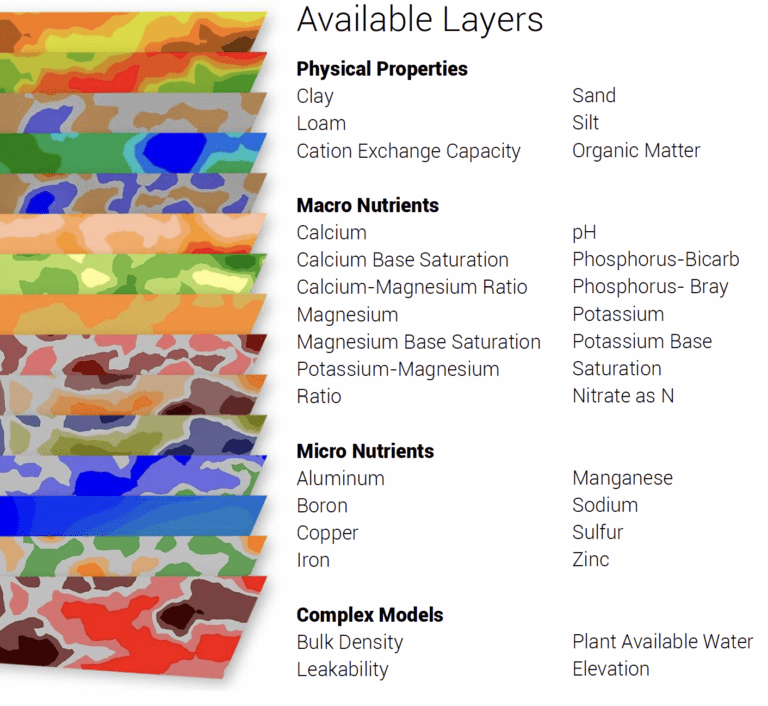
FarmTech processes the scan data into high-resolution nutrient maps — pH, organic matter, phosphorus, potassium, nitrate, CEC, and more, resolved every 10×10 feet. Every map lives in FarmIQ, overlaid with your satellite and machine data.
3. You Get a Plan
Variable-rate prescriptions for seed, fertilizer, and amendments. Generated from your actual soil, not regional averages. Delivered as files your equipment already reads — Topcon, John Deere, ISOXML, shapefile.
Maps in. Prescriptions out.
Files your equipment reads — day one.
The full nutrient picture for every field: pH, organic matter, phosphorus, potassium, nitrate, sulfur, zinc, and CEC. Every map loads automatically into FarmIQ — where it becomes the foundation for seasonal nitrogen monitoring, weed prescriptions, and year-over-year comparison.
Here's the difference: everybody else draws zones first, samples the zone, and assumes everything inside it is the same. We don't. We measure what's happening every 10×10 feet. The only time "zones" appear is when we write the prescription — and that's just so your controller and equipment can handle the data, not because the map got any coarser.
Prescriptions in every format your cab reads: PDF for review, shapefile for GIS, ISOXML for the console. Compatible with Topcon, John Deere, Case IH, New Holland, Ag Leader, Trimble, and Raven. If you tell us what's in your cab, we verify the format before delivery.
What We Map
Nutrients (N-P-K + micros)
Nitrogen, phosphorus, potassium, calcium, magnesium, sulfur — per acre. Optional micros: zinc, iron, manganese, copper, boron. The full nutrient picture, not just the two inputs you already suspect are an issue.
Organic matter + pH
LOI organic matter, soil pH, and buffer pH for lime recommendations. Organic matter moves slowly — mapped year-over-year, it tells you whether your management is building soil health or mining it.
EC + CEC + texture
Electrical conductivity, cation exchange capacity, soil texture (sand/silt/clay). The physical properties that drive water retention, nutrient buffering capacity, and why the northwest corner of that field always runs dry two weeks before everything else.
Proof: First Prescriptions Ran Live, Spring 2026
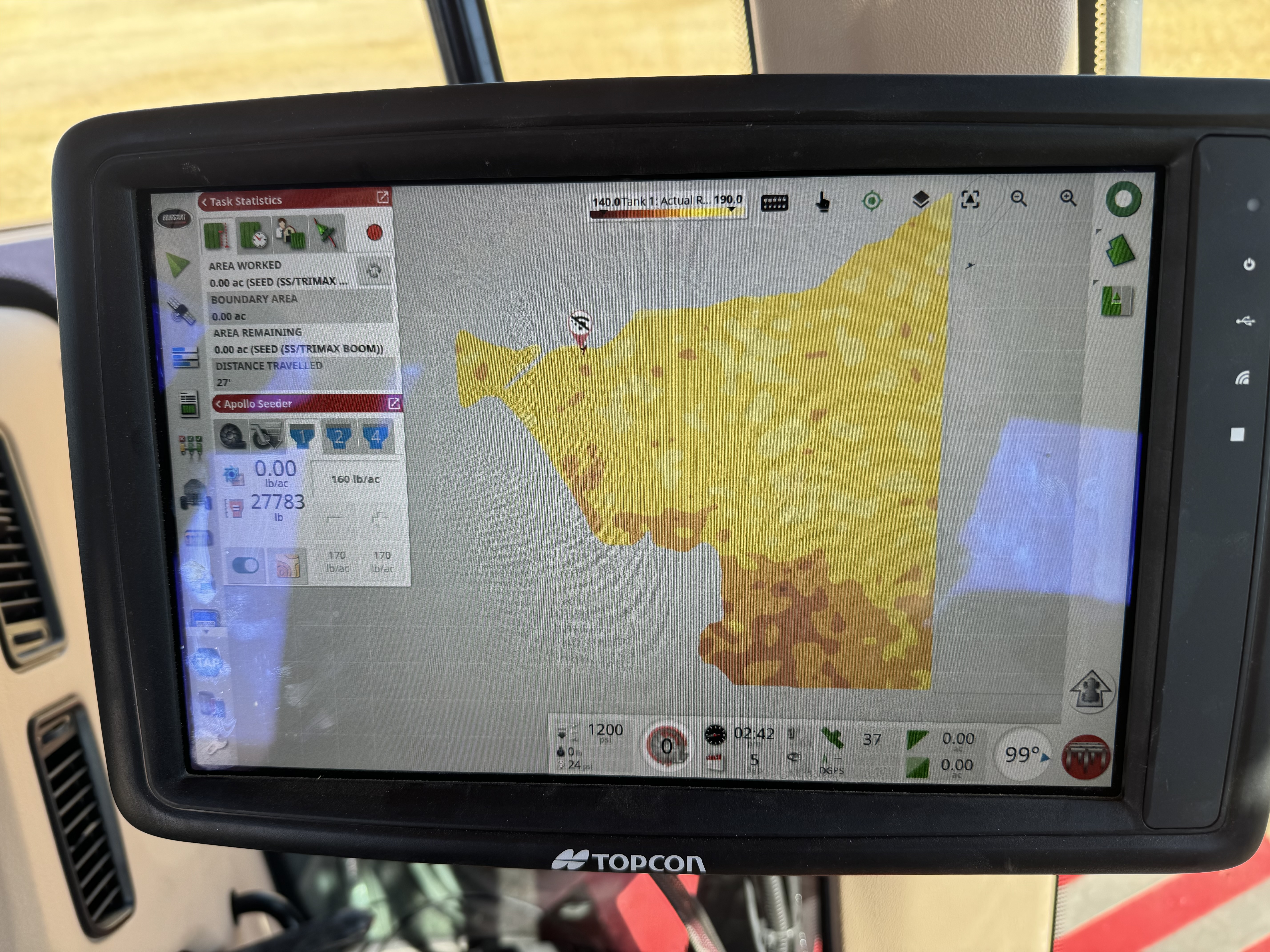
The first commercial prescriptions built on this pipeline ran on a seeder in spring 2026 — W02 field, 45 bu spring wheat target. FarmTech delivered a 10-zone phosphorus prescription built from soil samples, loaded it to Topcon TAP, and the seeder ran it the day we delivered the file.
It wasn't always this fast. Until fall 2024, every prescription was built by hand in a GIS — accurate, but slow, not scalable, and nothing the farmer could explore on their own. FarmIQ Soil RX changed that: interactive, repeatable, and scalable across every field we scan.
No GIS consultant. No file conversion. No agronomist on the phone. Variable rate used to mean a month of friction. Now it runs on delivery day.
Read the Weist Farms story →What you walk away with
- High-resolution nutrient maps: pH, OM, P, K, NO3, S, Zn, CEC
- Variable-rate prescription files for seed, fertilizer, and amendments
- Soil Health Summary PDF delivered after every job
- All data in FarmIQ — overlaid with satellite and machine data
- Annual remap option for year-over-year comparison
Common questions
$12.50/acre for scanning and sampling — full-service scan plus lab-analyzed soil samples, and the data is good for five crop seasons before a rescan. Prescriptions through FarmIQ Soil RX run $0.50/acre per nutrient, or $2.50/acre for all maps, as many prescription runs as you want per season. The right comparison isn't cost-per-acre for scanning — it's that against the cost of over-applying fertilizer on every acre that doesn't need it. Most operations recover the service fee through fertilizer savings in the first prescription season. See the full price list or contact us for a quote on your acreage.
Almost any time. The only conditions that stop a scan are big snow drifts or ice — frozen ground scans just fine. If you run crop/fallow, spring through summer on the fallow works great. If you're irrigated or recropping, right behind the combines is the best window. Tell us your rotation and we'll find the slot.
PDF for review, shapefile for GIS, and ISOXML for the cab. Compatible with John Deere, Case IH, New Holland, Ag Leader, Trimble, Raven, Topcon, and any variable-rate-capable system. If you tell us what's in your cab, we'll verify the format before we deliver — you shouldn't have to reformat a prescription file before you can use it.
You get everything: the point-sample dataset, interpolated raster maps for each nutrient layer, shapefiles, ISOXML prescriptions, and a written agronomic summary. All of it loads automatically into FarmIQ for year-over-year comparison. You own the data permanently — it's your soil, your history, your asset.
Ready to actually know your soil?
Active season, delivering maps to customer farms today. Most operations recover the service cost through fertilizer savings alone in the first application year. Tell us about your fields and what you're trying to accomplish.